
THOMAS—A Deeper Dive

Photo by Drew Farwell on Unsplash

Today I want to take a deeper dive into the THOMAS worksheet (Word version | PDF version), which I talked a little bit about in my post Teaching History: First Week of Class Resources. This is an assignment that I developed for graduate students based on Danna Agmon’s THOMAS framework for analyzing historical scholarship. THOMAS stands for Topic, Historiography, Organization, Methodology, Argument, and Significance.

I often pair this with Caleb McDaniel’s “How to Read for History” because I think it’s important to not assume that students already know how to be successful in our courses. This is no less true for graduate students, who are generally my target audience for this assignment. While McDaniel gives them key insight into how to read for their seminars, the THOMAS worksheet tells them what to look for. In other words, this assignment teaches them how to do the kind of reading that we sometimes refer to as “gutting” a book.

This is an enormously important skill for students to have. It can make reading for courses more efficient, not to mention preparation for comprehensive exams. I also sometimes frame the THOMAS worksheet as scaffolding for more involved assignments. When students are tasked with a historiographical essay, I encourage them to dissect their list of books using the THOMAS method. Students can then use the completed worksheets to more easily draw out points of comparison, giving them a starting point for analysis.

However, I’ve found that it’s not enough to tell students what they’re looking for; you also have to tell them where and how to look. This is disciplinary knowledge that has become second nature to many of us over time, and there’s no good reason not to share this with our students. To that end, I developed this handout, which describes where to find each of these elements, and what to look for.

I’ve also recorded the following videos—the first gives an overview of this framework, and the others explain each element in detail:

After I’ve graded all the worksheets for a given reading, I’ll generally also share my own version as a model. And although I do generally use this assignment with graduate students, it could also work with advanced undergraduates with the right amount of support. For example, you could start by giving students a partially completed handout and having them fill in the rest, or have them complete the worksheet in groups during a single class session.

Have you used something similar to teach reading strategies? Do you have your own method for “gutting” a book? Share them in the comments!
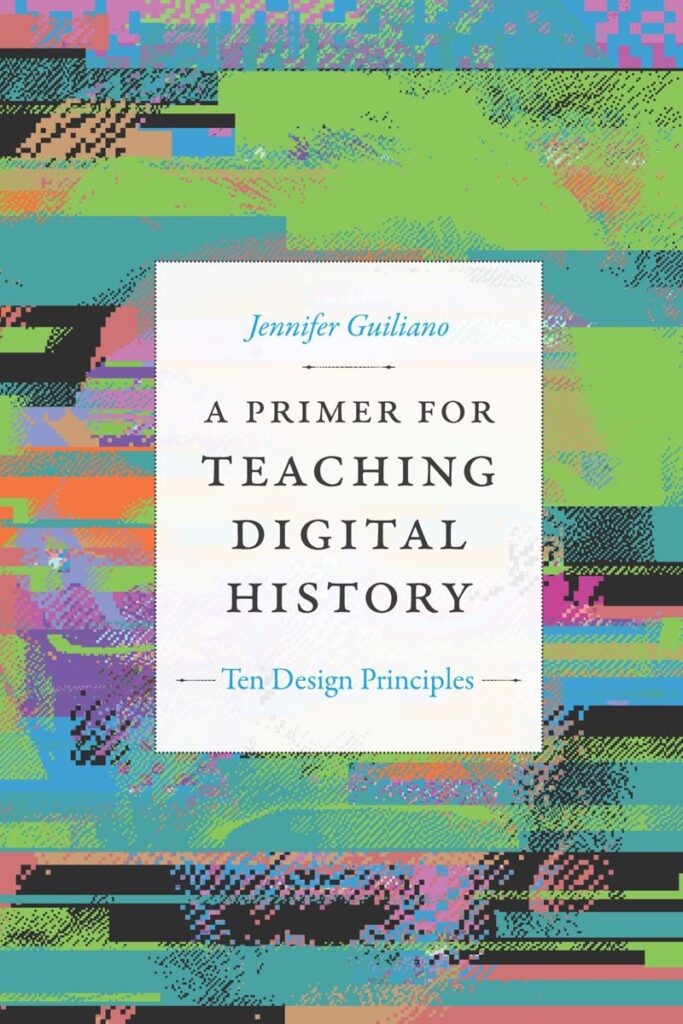

3 Takeaways from A Primer for Teaching Digital History

I was one of the unlikely many who caught Covid for the first time during the BA.5 wave this summer. While I was isolating at home, I had the chance to read A Primer for Teaching Digital History by Jen Guiliano, from the Design Principles for Teaching History series by Duke University Press. I had picked it up casually, but ended up being engrossed in it. It’s accessible, well-written, and full of great ideas—all of the things you want from a book on teaching.

Even though I’m not teaching digital history any time soon, I still found that Guiliano offered a lot of insights that I could apply to my teaching right now. Here are three of the big takeaways from A Primer for Teaching Digital History that I’ll be taking into my classroom this semester.

Student Collaborator’s Bill of Rights

This semester I’m building my graduate course on History, Memory, and the Public, which I teach on themes of race and memory in the United States, around a major public-facing project. A group of faculty from FIU and University of Miami have been working on a proposal for A People’s Guide to Miami, to be included in the A People’s Guide series from University of California Press, which sounded like just the right type of project for students in this course to help out with.

The students in my course will be writing A People’s Guide to Miami entries for possible use in both the book proposal and the final publication. I like to use projects like this one in my public history courses because it gives students a chance to apply what we’re reading to their work “in the field.”

However, before reading Guiliano’s book I hadn’t heard of the Student Collaborators’ Bill of Rights. This set of principles, which is itself based on the Collabortors’ Bill of Rights, describes what students should be able to expect in terms of compensation, credit, and control when participating in a project led by faculty. We will discuss both sets of principles early on in the semester, and, students will be able to opt out of contributing to the People’s Guide if they so choose.

The Importance of Peer Review

Guiliano points out that peer review is about more than students giving and getting feedback; it also fosters a sense of classroom community. However, I haven’t done much peer review in the past because, in my experience, students have a hard time giving each other useful feedback.

Guiliano offers a couple of solutions for this. One is to provide student peer reviewers with a checklist of assignment requirements. Another is to ask student peer reviewers what they would do differently rather than asking them to assess a peer’s work in terms of its quality.

With these strategies in mind, I’m asking students to turn in a draft of their People’s Guide entry in early November for peer review, so that they can read one another’s work, get some valuable feedback, and make revisions accordingly by the end of the semester. And of course assessing one another’s work will also help students to better understand the assignment for themselves.

Getting Better is What Matters

When we talk about pedagogy, whether it’s in a faculty workshop or in a blog post, we’re often talking about the very best version of our teaching. I know that I can find this to be kind of discouraging, because it sounds like everyone else is brilliant in the classroom, whereas all I can often think about are the things I could have done better or differently. And sure enough, while reading A Primer for Teaching Digital History I thought a lot about my teaching missteps in the past.

That’s why I was grateful that Guiliano ended her book this way: “Don’t forget that what makes you a great teacher is your desire to continually improve your own pedagogy.”

This was so reassuring! It’s a good reminder that if you’re in the position to hear about how lots of other people are teaching, then you’re probably doing something right yourself, even if that right thing is just to get a little bit better at it.

Setting Norms for Class Discussion

Photo credit: Headway

This summer I taught a six-week graduate seminar on Florida’s Black history. The course represented a couple of firsts for me: my first time teaching a course focused specifically on the subject, my first time teaching a graduate seminar online, and my first time setting intentional norms for class discussions.

I got the idea from a Lumen Circles fellowship program on evidence-based teaching that I participated in last spring. It was geared toward undergraduate instruction, and the only courses coming up on my calendar were for graduate students. So when we got to talking about using discussion norms to foster belonging in the undergraduate classroom I thought, Graduate seminars are a different beast—this doesn’t really apply to me.

Then I remembered graduate courses that I’ve taught in the past where discussion norms would have been really helpful. (And if I’m being honest, I would have benefited from such norms when I was a graduate student who sometimes confused snarky comments with intellectual engagement.) My teaching often focuses on the historical context for hot-button issues, and here class discussions can get passionate—sometimes to the point that feelings are hurt, students disengage, and managing the classroom becomes stressful. The problem in these cases was not that students disagreed with or challenged one another, but that the tenor of our conversations got in the way of genuine listening and learning. In retrospect, we really could have used an agreed-upon set of discussion norms to get us back on track.

So for my online seminar this summer, I made setting these norms one of our first tasks as a class. First, I asked students to write a short discussion board post responding to the following questions:

  • What does respect look like in this space?
  • How can we make this space where we can feel brave to speak up and engage with each other? How should we respond when we feel uncomfortable?
  • What expectations do we wish to set so that we can all make the most of our time together?
  • Finally, how do we want to respond when someone breaks a community expectation? What will accountability look like in our space?

Then I asked them to annotate and comment on a set of draft discussion ground rules adapted from Juan C. Garibay, “Creating a Positive Classroom Climate for Diversity.” Once they were done, I incorporated their feedback into the final set of ground rules.

I have to say that discussions—all of which were done using audio and video comments on VoiceThread—went exceptionally well. Having discussion norms in place also helped me to feel more secure as an instructor, because I knew that I had taken care to set us up for success as a learning community. This is something that I’ll definitely be carrying forward in my teaching.

If you’d like to do the same, feel free to borrow any and all of this. If you click “File” and “Make a copy” on the discussion ground rules Google Doc above, you can save it to your Google Drive account to edit for your own purposes. And of course this is just one way to engage students in setting ground rules for your learning space—feel free to share your own approaches in the comments below.

Teaching History: First Week of Class Resources

Photo Credit: Brett Jordan

One of the things that I’ve tried to do more and more since I started teaching is to focus on what I think of as the foundations of history education. This includes the habits of mind that develop over the course of our training, which few—if any—of our students will have mastered.

This annotated list of resources includes readings and activities that aim to build students’ foundational skills in the study of history. I’m calling these “first week of class resources” because that’s when I often introduce them, but they work well for any point in the quarter or semester, no matter what kind of history you teach.

Thomas Andrews and Flannery Burke, “What Does It Mean to Think Historically?”

You can assign this as a short reading for the first week of the semester, but I often make the 5 Cs the focus of a mini-lecture in a face-to-face course or a series of videos for a hybrid or online course. As you go throughout the semester, call back to these when your course content illustrates any one of these themes.

W. Caleb McDaniel, “How to Read for History”

This is one that I wish I had been assigned as an undergrad or even in grad school—hey, if I’m being honest, I still have to fight the urge to read every book from cover to cover. McDaniel offers helpful advice for how to read history monographs effectively by skimming for key information and reading in three discrete stages. This works great for an undergraduate course if you’re assigning one or more monographs, and I’ve used it with graduate students as well.

W. Caleb McDaniel, “How to Discuss a Book for History”

Another really useful reading from McDaniel, one that is well-suited for seminars and other discussion-based courses. Just as students often need guidance in how to read monographs, they often need guidance in how to discuss them. This post makes explicit our expectations for doing so.

Cornell Note Taking System

I’ll confess that this isn’t something that I’ve assigned before, although I have talked quite a bit with students about taking notes in class. It seems to me that a large number of students don’t take notes in my lecture courses, and I suspect that it’s not just me. It may be that note-taking is no longer being taught in lower grades, and so students don’t know how to take notes. In any case, this page explains the Cornell note-taking system, and links to a publicly available Canvas module with exercises, assessments, and reflections.

PAPER Worksheet (Word version | PDF version)

If there’s one skill that is absolutely foundational to history education, it’s primary source analysis. However, most students don’t know quite what we mean when we ask them to analyze a historical document. This simple worksheet, based on Patrick Rael’s “How to Read a Primary Source,” breaks that analysis down into five sets of questions that students can use as a first step toward longer assignments.

THOMAS Worksheet (Word version | PDF version)

I’ll talk more about this in a later post, but this is another worksheet that I developed, this time based on Danna Agmon’s THOMAS framework for analyzing historical scholarship. I will say that I’ve had more success in using this with graduate students than with undergraduates, but with the appropriate support, I think this could work well for advanced undergraduates.

Paul B. Sturtevant, “What Can You Do with That History Degree?”

In a better world, we wouldn’t have to constantly be defending the value of humanities education. Unfortunately, that’s not the world we live in. With that in mind, you might want to spend some time in the first week of the semester talking with students about what comes after a degree in history. This article, which uses federal employment data, shows that history majors are competitive on the job market, which can both reassure anxious history majors and bring more students into our courses. I would especially recommend this if you’re teaching core or introductory courses that have large numbers of non-majors and students who are still deciding on their academic path.


How do you like to teach foundational skills in history? Did you have a teacher at some point who helped you to build your own skills? Feel free to share in the comments!

css.php